The Tee Section shape is the outline of a steel tee (a T bar, or a tee split from a universal beam): a flange across the top with a web hanging down from its middle. It is one closed profile, sized the way section tables give it: Depth, Width, Web Thickness, Flange Thickness, Root Radius and Toe Radius, with an optional Flange Slope for tapered flanges. Use it to cut a tee-shaped profile, such as an end plate or a template that matches a tee.
The shape is also found in search as Tee, T Section and T Bar.
It appears in the shapes library under Other Shapes.
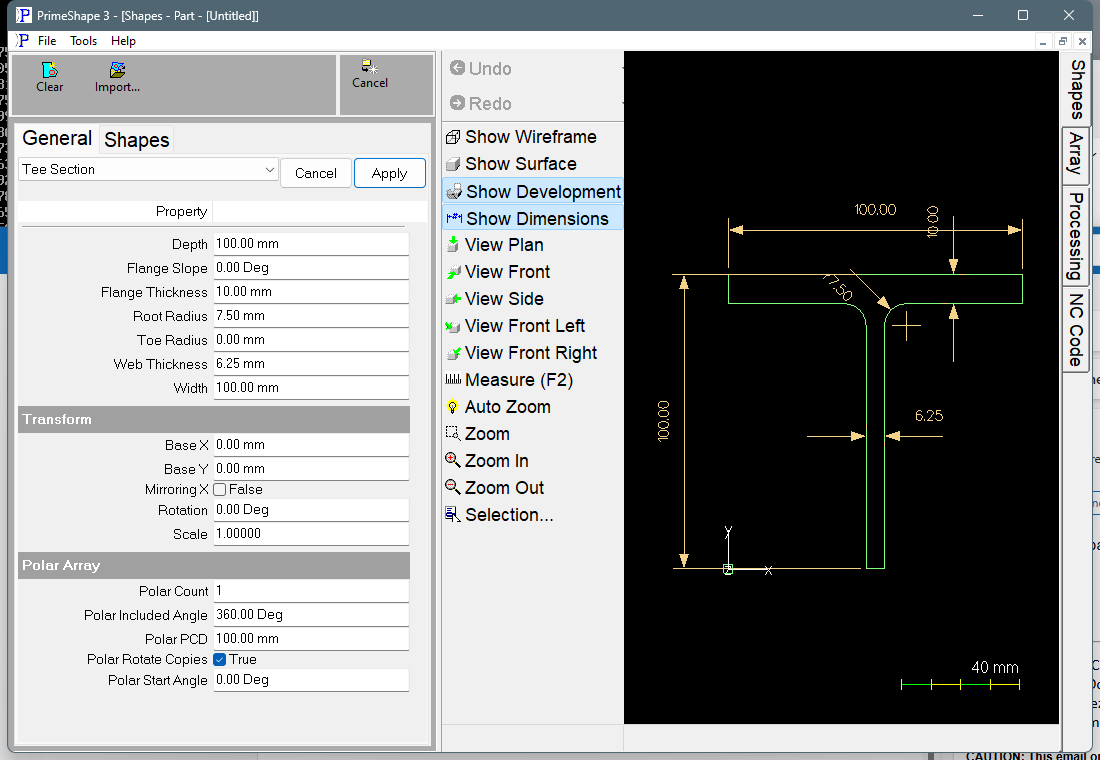
Tee Section in PrimeShape: the property page (left) and the shape with its dimensions (right).
Insert point and direction
The insert point (Base X, Base Y) is the bottom left corner of the section's bounding box. It is not on the outline: the left end of the flange is directly above it, and the foot of the web is level with it. The section extends Width to the right of the insert point and Depth upward.
The flange is across the top and the web points down (-Y). The foot of the web runs from (Width - Web Thickness) / 2 to (Width + Web Thickness) / 2 along the bottom edge, so the web is centred on Width.
The outline is built anticlockwise from the foot of the web: across the foot, up the right face of the web, round the root fillet and out along the underside of the right flange, round the toe fillet and up the right flange tip, back across the top of the flange, down the left flange tip, round the toe fillet and along the underside of the left flange, round the left root fillet and down the left face of the web.
Only the four inside corners are rounded: the Root Radius where each side of the flange meets the web, and the Toe Radius on the underside edge of each flange tip. The outside corners (the top corners of the flange and the foot of the web) are always sharp.
The dimensions drawn on the shape are named after their properties, so clicking one edits that value. Depth is dimensioned along the left face of the web, from its foot to the top of the flange. Width is dimensioned across the top. Web Thickness is dimensioned across the web, and Flange Thickness on the right flange half way along the outstand. Root Radius and Toe Radius are dimensioned on the right-hand fillets, and each is hidden when its value is 0.
Properties
Property |
Description |
Default |
Depth |
Overall depth of the section along Y, from the foot of the web to the top of the flange, flange included (mm or inch). Must be greater than 0. |
100 mm (4 in) |
Width |
Overall width of the flange along X, tip to tip (mm or inch). Must be greater than 0. Each flange outstand is (Width - Web Thickness) / 2. |
100 mm (4 in) |
Web Thickness |
Thickness of the web (mm or inch). Must be greater than 0 and less than Width. |
6.25 mm (about 0.25 in) |
Flange Thickness |
Thickness of the flange (mm or inch). Must be greater than 0. With a Flange Slope it is the thickness half way along each flange outstand, as section tables give it; the flange is then thicker at the web and thinner at the tips. |
10 mm (about 0.4 in) |
Root Radius |
Radius of the fillet on each side where the flange meets the web (mm or inch). Cannot be negative. 0 gives a sharp corner. |
7.5 mm (about 0.3 in) |
Toe Radius |
Radius of the fillet on the underside edge of each flange tip (mm or inch). Cannot be negative. 0 gives a sharp corner. |
0 |
Flange Slope |
Slope of the underside of each flange outstand, for tapered flanges (degrees, 0 to 45). 0 gives a parallel flange. The flange thickness at the tip is Flange Thickness minus tan(Flange Slope) × outstand / 2, and at the web it is Flange Thickness plus the same amount, where outstand is (Width - Web Thickness) / 2. |
0 degrees |
The default size is about that of a tee split from a 203 x 102 universal beam.
Limits
The property page shows Warning: Cannot build shape from these parameters and no outline is drawn when any of these is true:
•Depth or Width is 0 or less.
•Web Thickness or Flange Thickness is 0 or less.
•Web Thickness is equal to or greater than Width.
•Flange Slope is less than 0 or more than 45 degrees.
•Root Radius or Toe Radius is negative.
•The Flange Slope is so steep that the flange tips have no thickness: Flange Thickness minus tan(Flange Slope) × outstand / 2 is 0 or less.
•The flange is too thick for the Depth: Flange Thickness plus tan(Flange Slope) × outstand / 2 (the flange thickness at the web) reaches Depth, which leaves no web below the flange.
•Root Radius or Toe Radius is too large for the section. Each fillet uses up a length along each side it sits on: its radius at a square corner, and more than its radius where the flange underside is sloped. The fillets on one side must fit within that side. On the underside of a flange outstand, the Root Radius and Toe Radius together must fit within the outstand. The Root Radius must fit along the web face below the flange, and the Toe Radius must fit within the flange tip thickness.
The web always points down (-Y) before the Transform properties are applied. Use Rotation in the Transform properties to turn the section. For an I beam, channel or angle, use the I Beam Section, Channel Section or Angle Section shapes. They take the same Depth, Width, Root Radius and Toe Radius; an Angle has a single Thickness for both legs and no Flange Thickness or Flange Slope.
Every 2D shape also has the Transform properties (Base X, Base Y, Rotation, Scale, Mirroring X) and the Polar Array properties, listed after the shape's own properties.